


If you’ve ever Googled “murder mystery dinner party,” you’ve probably landed on one of two things: a murder mystery box set shipped from Amazon, or a company offering to send professional actors to your home. Both have their place. But neither is what I do — and if you’re trying to figure out which kind of murder mystery is right for your group, it helps to understand what actually separates them.
The murder mystery box set
Murder mystery box set games have been around since the 1980s. The format hasn’t changed much. You open the box, hand out character cards and scripts, and follow a pre-written story toward a pre-written solution. Every player reads their lines. Every clue is scripted. The murderer is fixed, but nobody improvises anything — you’re following a path that was laid out before your guests arrived.
For small groups of four to eight people who’ve never tried a murder mystery before, a murder mystery box set can be a fun introduction to the format. They’re low-pressure because everything is provided. Nobody has to think too hard. You follow the instructions and arrive at the answer.
The limitations show up quickly. Most murder mystery box sets cap out at eight players — sometimes ten. The scripted format means quieter guests hide behind their lines and more extroverted guests can’t run with an idea when it’s actually funny. The “solving” element is often more of a reveal than a deduction — you follow the clues, you reach the conclusion, you close the murder mystery box set. It’s closer to a board game than a dinner party.
The actor-led experience
The other common option is hiring a company to bring professional actors to your venue. One or two actors play the victim and perhaps a suspect and the detective, while your guests try to extract information from them. This works well as entertainment — you’re watching something rather than doing something. Think of it as interactive theatre.
The downside is the dynamic it creates. Your guests become an audience, not a cast. The actors carry the evening; your friends are secondary characters in someone else’s story. And for a group of people who actually know each other — who have history, private jokes, years of shared context — that’s a significant waste of potential.
What improvised games do differently to an actor-led game and a murder mystery box set
My games have no scripts and no professional actors. They never have. The premise is simple: your guests are the entertainment, so the game should get out of their way and let them be.
Before the event, every player receives a detailed character briefing — who they are, their background, their relationships to the other guests, and their connection to the murder. On the night, guests arrive and spend around thirty minutes mingling in character — getting comfortable in their role, meeting the other suspects, finding their feet. This mingle period also gives late arrivals time to get settled without disrupting the main event.
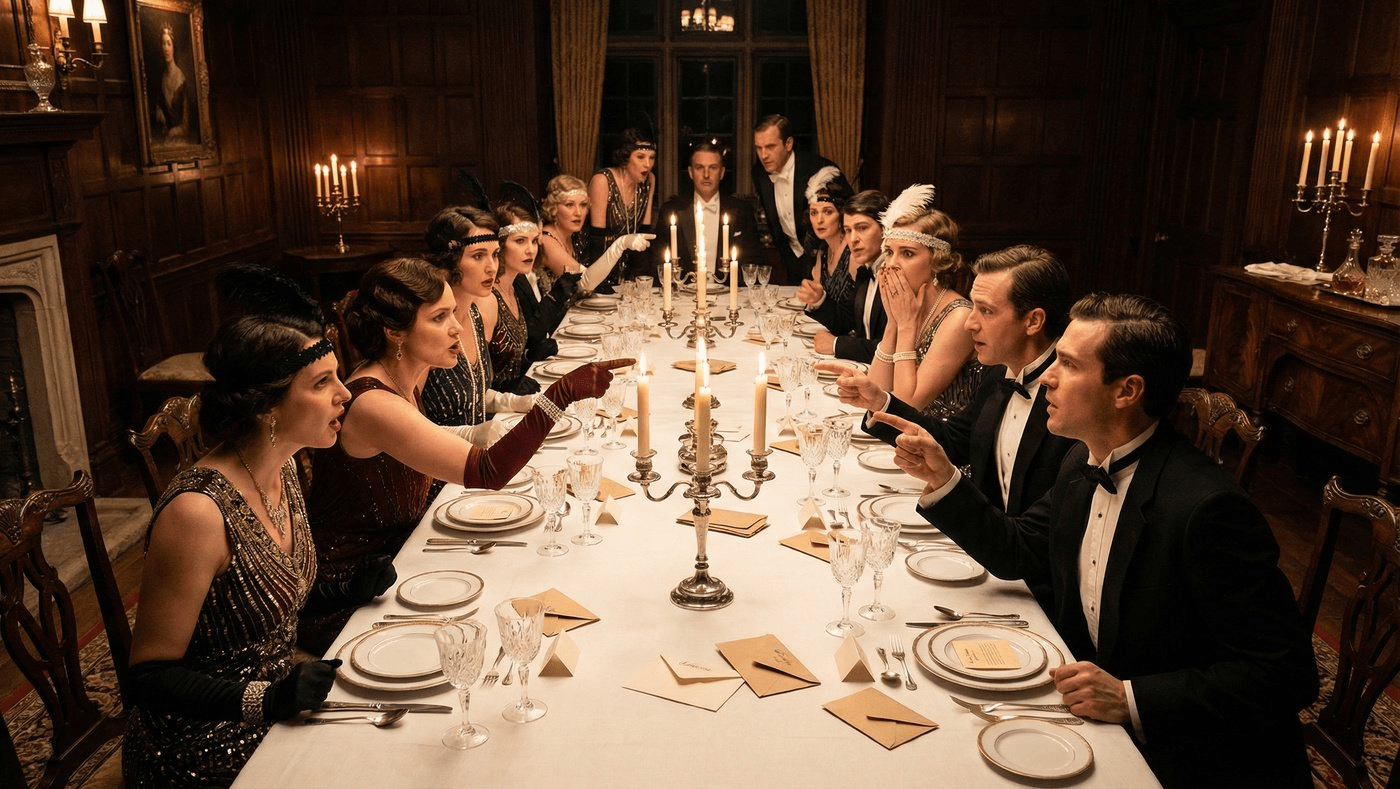
When everyone sits down for dinner, they find their secrets waiting for them at their place setting: one secret to reveal during the evening, and one to keep at all costs. Nobody — including the murderer — knows their hand until that moment. Clue cards are released progressively through the meal, each one deepening the tension and narrowing the field of suspects.
The evening needs a host — typically the person who organised the event — whose job is not to perform but to manage. They keep guests in character when people start slipping back into being themselves. They keep the action moving when the conversation stalls. They read the room and call the endgame when all the secrets are out. At that point they invite the murderer to confess, then ask the group to vote for best male character, best female character and best dressed. In fifteen years of running these evenings, those three votes have produced some of the most hotly contested debates of the night.
What this format produces is an evening that no script could have written. The accountant who turns out to be a devastatingly convincing liar. The reserved colleague who transforms into the most theatrical suspect at the table. The moment when two guests realise their characters have conflicting stories and have to decide, in real time, which of them is going to crack first. These moments happen because the game created the conditions for them — not because anyone was told to make them happen.
The practical differences
A murder mystery box set typically accommodate four to ten players. My games range from 12 to 30 players. This isn’t a coincidence — the improvised format actually gets better with more people. More guests means more subplots, more accusation vectors, more chaos. A table of twenty people improvising their way through three courses produces something that a table of six following scripts simply cannot.
A murder mystery box set is designed to be played once, after which the solution is known and the game is finished. Improvised games can be replayed with different groups indefinitely — the characters and clues stay the same, but the evening they produce will never be the same twice, because the evening is made by the people in the room.
A murder mystery box set requires no advance preparation from guests. Improvised games ask guests to read their character briefings before the event — typically one to two pages — which means they arrive already invested. In fifteen years of running these evenings, I’ve never had a guest who resented the preparation. I’ve had plenty who admitted they reread their character brief several times in the days leading up to the event, trying to work out who else might be the murderer.
Which one is right for your group?
If you have a group of four to six people, are hosting something casual, and want something low-effort to try for the first time, a murder mystery box set is a reasonable starting point. Go in with calibrated expectations — it’s an activity, not an experience.
If you have a group of twelve or more, want an evening that your guests will still be talking about six months later, and are willing to trust the people around your table to be more creative and funnier than any script could plan for — an improvised game is the one to choose.
The difference isn’t really about scripts versus improvisation. It’s about what you believe your guests are capable of. I’ve always believed they’re capable of more than most murder mystery products give them credit for. Fifteen years of evenings have consistently proved me right.
The Murder Mystery Guide offers fully improvised Print-and-Play murder mystery dinner games for 12—30 players. All 11 titles are available as instant digital downloads at www.murdermysteryguide.com.
View media coverage for The Murder Mystery Guide